0
0 item
View CartYour cart is empty
MON - FRI 10:00 AM - 06:00 PM EST.
SAT - SUN holiday
In the world of aesthetic medicine, demand for treatments that deliver natural-looking and long-lasting rejuvenation, as well as stimulate collagen production, continues to grow. Patients today want more than just quick fixes – they are increasingly interested in treatments that stimulate their body’s own regenerative processes and provide gradual, subtle improvements. This is where biostimulatory dermal fillers have gained remarkable popularity.
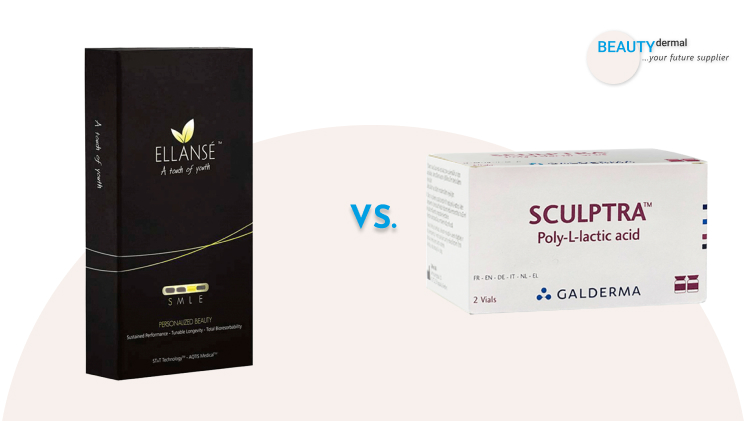
Among the most widely discussed options are Ellanse and Sculptra. Both treatments go beyond simple volume replacement by encouraging collagen production, helping restore facial structure and skin quality over time. But how do they differ, and which one may be more suitable for particular treatment goals? Understanding the mechanisms, longevity, advantages, and ideal patient profiles for each filler will help you make informed decisions when planning treatments.
Traditional hyaluronic acid fillers provide immediate volume by physically filling tissue. While effective, their results are typically temporary and depend on the presence of the injected material. Biostimulatory fillers such as Ellanse and Sculptra work somewhat differently from traditional dermal fillers. Instead of simply occupying space, they trigger the body’s natural collagen production, gradually improving skin structure, firmness, and elasticity. Collagen plays a crucial role in maintaining youthful skin. However, starting in our mid-20s, collagen production declines by about 1% each year. Over time, this lost collagen contributes to:
By stimulating collagen formation, biostimulatory fillers help address the root cause of these changes rather than just masking them while causing little to no inflammatory tissue reactions (or adverse reactions), regardless of a patient’s skin type.
“Biostimulatory fillers represent a paradigm shift in aesthetic medicine. We are no longer just chasing lines and filling voids; we are actively signaling the body’s fibroblasts to regenerate structural proteins, effectively reversing the biological clock of the skin.” — Dr. Sarah Jenkins, MD, Board-Certified Dermatologist
Ellanse is a unique collagen-stimulating and polycaprolactone-based dermal filler that consists of polycaprolactone (PCL) microspheres suspended in a carboxymethylcellulose gel carrier. It is worth mentioning that Ellanse’s unique formulation allows for long-lasting results, with some studies indicating effects lasting up to four years.
The cosmetic treatment that involves the Ellanse polycaprolactone-based collagen stimulator works in two phases:
This dual action that involves instant volumization and gradual improvement in body’s collagen production offers both immediate and progressive results.
One of the key advantages of the product is its customizable longevity. Namely, Ellanse results are visible immediately and can last from 1 to 4 years, depending on the variant. This flexibility allows practitioners to tailor treatments according to patient preferences and long-term aesthetic goals.
Ellanse is typically used for deep dermal and subdermal injections, making it suitable for restoring structural support and reducing wrinkles in areas such as:
Because of its structural properties, it is often used to enhance facial contours and initiate volume restoration in the facial area.
Some of the main benefits of an Ellanse treatment session include:
However, because of its durability, practitioners must inject it with careful planning and precise technique.
Sculptra is another well-known biostimulatory injectable. It contains poly-L-lactic acid (PLLA) particles, a biodegradable synthetic polymer that has been used in medical devices for decades.
Unlike injectable fillers that create instant volume and immediate results, Sculptra works gradually, stimulating collagen production over several months, leading to a natural, progressive improvement in skin texture and volume. After injection:
Because of this mechanism, the results develop slowly and progressively, which many patients appreciate for its subtle, natural-looking transformation. It is also worth mentioning that Sculptra requires multiple treatment sessions, typically 2 to 3 sessions spaced 4-6 weeks apart, for optimal outcomes. This staged approach allows practitioners to gradually build volume and refine results.
Results from Sculptra can last up to two years or longer, depending on individual metabolism and treatment protocol.
Sculptra is widely used for global facial rejuvenation, including:
Sculptra has been FDA-approved since 2009 for facial volume loss. Also, it is particularly effective for patients experiencing diffuse volume loss rather than isolated wrinkles.
Key benefits include:
Because results appear slowly, patient education is important so expectations remain realistic.
“Sculptra is essentially a fertilizer for your own collagen. It requires patience, as the true peak of results won’t be visible until months after the final session. However, the reward is a completely natural restoration of facial proportions that doesn’t look ‘filled’.” — Dr. Michael Chen, PhD, Facial Plastic Surgeon
As investigational dermatology specialists mention, although both products belong to the same category of collagen-stimulating fillers, they differ in several important ways.
| Feature | Ellanse | Sculptra |
|---|---|---|
| Active Ingredient | Polycaprolactone (PCL) | Poly-L-lactic acid (PLLA) |
| Initial Results | Immediate volumization | Gradual, no immediate volume |
| Longevity | 1 to 4 years (depending on variant) | Up to 2 years |
| Required Sessions | Usually 1 session | 2 to 3 sessions |
| Primary Use Case | Targeted structural lifting and contouring | Diffuse, global volume restoration |
When treated with Ellanse, a patient might expect:
After a Sculptra injection, in its turn, it is typical to have:
For patients seeking more youthful appearance that would be noticeable instantly, Ellanse may be the preferred option.
Both fillers offer long-lasting results, but Ellanse stands out for its extended duration. Namely:
For patients wanting a very long-lasting firmer skin, Ellanse may provide a stronger advantage.
The result of Ellanse is often achieved in one session. Also, additional touch-ups may be needed depending on the goals of a patient. Sculptra, in its turn, usually requires multiple sessions to provide a patient with desired results. It is characterized by a aradual build-up of collagen. This difference can influence patient convenience and clinic scheduling.
Ellanse is an immediate volumizing gel based ob PCL microspheres that stimulate collagen. While Sculptra is based on PLLA microparticles that trigger collagen production with no immediate volumizing effect.
Ellanse is often chosen for:
Sculptra is commonly used for:
A SAFETY NOTE:
Both Ellanse and Sculptra have excellent safety profiles, but some common side effects may include swelling or bruising at the injection site. Also, tenderness or redness at the injection site is often seen with Ellanse and Sculptra treatments. Both Ellanse and Sculptra can cause rare complications, including inflammatory tissue reactions after treatment (luckily, these adverse reactions are exceptionally scarce).
Both Ellanse and Sculptra target the mid-face region and effectively address signs of aging. Still, selecting the best dermal filler depends on several factors:
Both Ellanse and Sculptra are powerful biostimulatory dermal fillers that help restore facial volume of the face and improve skin quality by stimulating natural collagen production. Ellanse offers the advantage of immediate correction and exceptionally long-lasting results, while Sculptra provides gradual, natural-looking rejuvenation through progressive collagen stimulation.
The right dermal filler choice ultimately depends on the patient’s treatment goals, desired speed of results, and overall facial rejuvenation plan. For medical professionals looking to incorporate brand-name cosmetic injectables into their practice, both Ellanse and Sculptra – along with a wide range of other medical and cosmetic injectables – can be conveniently ordered through BeautyDermal, an online supplier dedicated to supporting aesthetic practitioners worldwide. So, no matter whether you would like to buy Ellanse fillers or purchase Sculptra products, do it advantageously today!
Neither is objectively “better.” The ideal choice depends on your specific goals. Ellanse is better for immediate volume and targeted contouring, while Sculptra is ideal for gradual, widespread facial volume restoration and subtle texture improvement over time.
While they are not typically injected into the exact same anatomical plane at the exact same time, an experienced practitioner may use them in combination across different areas of the face as part of a comprehensive, full-face rejuvenation plan.
Discomfort is usually minimal. Both treatments are generally administered using fine needles or cannulas, and many formulations or protocols include mixing the product with lidocaine (a local anesthetic) to ensure patient comfort during the procedure.