0
0 item
View CartYour cart is empty
MON - FRI 10:00 AM - 06:00 PM EST.
SAT - SUN holiday
Botulinum neurotoxin type A injections are among the most popular solutions for facial rejuvenation and dynamic lines reduction. They are also commonly used for a wide range of therapeutic uses to pause contraction of the targeted muscles, providing desired pain relief and relaxation. New variations of botulinum toxin products occur on the market every year, and staying informed about all the changes, variations, and available options is crucial to be considered a reliable medicl professional.
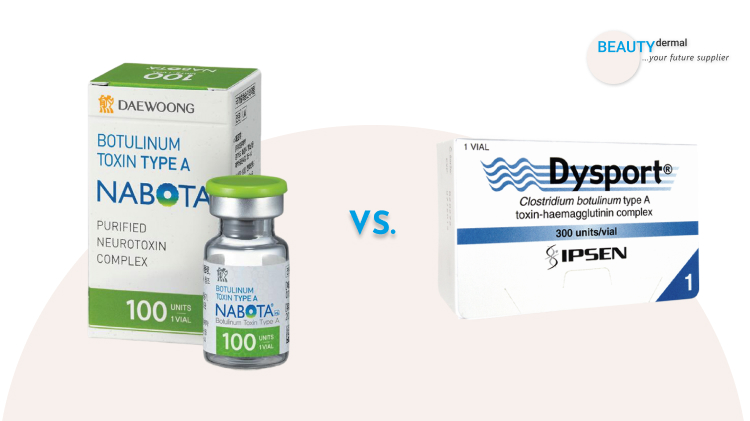
Today, we would like to compare tradition with novelty: Dysport and Nabota. While the first brand has been used and loved for many years in the USA, the second one is the new name on the market. Moreover, Nabota is the first South Korean brand (manufactured by Daewoong Pharmaceutical) that has been FDA-approved in America! Comparing those is a must to understand the peculiarities better and incorporate new solutions into your clinic’s routine, so let’s discuss these two brands!
As it has been already mentioned, Nabota and Dysport belong to the botulinum toxin type A family; they are widely used for various cosmetic and therapeutic purposes and are known for their efficacy and safety. These products are widely used in aesthetic medicine for wrinkle reduction and facial rejuvenation, and can also be quite helpful in certain medical treatments (primarily those related to muscle spasticity).
Once Dysport and Nabota have received their FDA approval, they have started to be considered perfect alternatives to Botox, which is known as the most popular botulinum toxin on the market nowadays. The demand for customizable treatments in the beauty industry grows, which can explain the occurrence of various botulinum toxin solutions with similar compositions and clinical usage recommendations. The goal is to find the most suitable option for each patient to ensure their satisfaction with the treatment.
| Product Entity | Active Neurotoxin Toxin Strain | U.S. FDA Approval Year | Primary Approved Aesthetic Indication |
|---|---|---|---|
| Nabota (PrabotulinumtoxinA) | 900 kDa Purified Type A complex | 2019 (Marketed as Jeuveau in the US) | Temporary improvement of moderate to severe glabellar lines |
| Dysport (AbobotulinumtoxinA) | 300–500 kDa Hemagglutinin complex | 2009 | Temporary improvement of moderate to severe glabellar lines |
To better understand the peculiarities of Dysport and Nabota treatments, it is important to know these products’ main features, both common and distinct. We are going to mention all the essentials, so buckle up and let’s recollect the details together.
Nabota is a highly purified botulinum toxin often marketed as a premium Korean product. It’s known for its streamlined, purified formulation, which provides a faster onset of action and longer-lasting effect. Dysport’s formulation includes proteins that help it spread more evenly in treatment areas, making it ideal for larger regions, such as the forehead.
Both solutions work in similar ways: they block nerve signals to targeted facial muscles, preventing their contractions and thus smoothing wrinkles. The effect is temporal and depends on the individual patient characteristics, just as with other cosmetic injectables for skin rejuvenation.
“Nabota’s high structural uniformity makes it an exceptionally predictable neuromodulator for precise focal points, whereas Dysport’s higher field diffusion is structurally superior for large areas like the frontalis.” — Dr. Kenji Sato, MD, PhD, Aesthetic Plastic Surgeon
In aesthetic medicine, Nabota and Dysport target nerves that control muscle movement to smooth out facial wrinkles via muscle relaxation. Dysport tends to work a little faster, but both brands demonstrate comparable efficacy and high levels of patient satisfaction.
Generally, desired outcomes can be easily achieved with both Nabota and Dysport. They have similar target areas, but the levels of effectiveness in each one vary, which is why knowing the most beneficial areas is crucial.
Nabota improved glabellar frown lines in 85.4% of subjects. Dysport is ideal for treating larger areas like the forehead due to its high diffusion; its smaller molecular structure allows it to diffuse more easily.
In the medical field, these brands are often used for such conditions as excessive sweating, TMJ, chronic migraines, cervical dystonia, and others. All procedures must be performed by licensed, trained medical professionals with a thorough knowledge of facial anatomy to ensure a safe experience in the clinic.
| Clinical Attribute | Nabota Profile Parameters | Dysport Profile Parameters |
|---|---|---|
| Purification Index | 98.7% via advanced Hi-Pure technology sequences | Standard multi-stage column chromatography separation |
| Active Radius Spread | Highly localized focal placement focus | Broad directional diffusion field patterns |
| Target Treatment Zones | Focal point lines (Glabellar 11s, specific asymmetry corrections) | Broad surface regions (Forehead, deep hyperhidrosis fields) |
Even though both brands have similar recommended injection sites, the doses still vary and must be considered when tailoring the treatment plan. For Nabota, the procedure typically involves 4 Units injected into each designated site, for a total of 20 Units. Dysport is usually administered at 10 Units per injection site across the same five-site pattern, bringing the total dose to 50 Units for glabellar lines. The exact dosage may vary depending on the treatment area, the severity of the lines, muscle strength, and the patient’s individual needs. In some medical applications, higher doses may be required to address specific concerns.
As for the onset, Dysport has a rapid onset and shows results within 24 hours for wrinkle reduction. It tends to work faster than other injectables in many cases due to its diffusion properties. Nabota is known for its relatively fast onset, with visible effects often appearing around two days after treatment. Considering the longevity, Nabota effects last approximately three to four months. Dysport’s effects can last up to five months.
To maintain results, medical professionals may recommend follow-up or maintenance treatments. Both Nabota and Dysport have demonstrated safety and effectiveness with repeat use, but outcomes can vary from person to person. Factors such as metabolism, treatment history, dosage, and individual muscle response can all influence how quickly results appear and how long they last.
Both Nabota and Dysport are used to reduce wrinkles and treat certain medical conditions. Choosing between them depends on the patient’s goals, treatment area, desired results, and individual response.
Nabota is commonly used to relax targeted facial muscles and soften fine lines, especially frown lines between the eyebrows. Studies show that many patients report high satisfaction after treatment due to a smoother, refreshed appearance.
Dysport is also used for cosmetic and medical purposes. It helps reduce dynamic wrinkles, including frown lines, crow’s feet, and forehead lines. Research shows that Dysport can significantly improve glabellar lines, with results lasting up to four months.
A qualified medical professional can recommend the most suitable option based on the patient’s needs and facial anatomy.
Both injectables have similar side effect profiles including injection site pain and bruising, though Nabota has fewer side effects compared to other brands. More common reactions also include temporary redness and swelling. Serious side effects are rare but can include temporary muscle weakness, allergic reactions, and droopy eyelids, which is why informing a specialist about the warning signs is crucial to ensure a safe experience with these brands.
“The risk of side effects like ptosis is drastically minimized when the baseline differences in diffusion parameters between abobotulinumtoxinA and prabotulinumtoxinA are strictly accounted for in clinical layout mapping.” — Dr. Elena Rostova, MD, Dermatologist
Dysport may have a higher initial cost than Nabota, as Nabota is typically priced 20-30% lower than Botox. However, touch-up treatments are required more rarely with Dysport, which is why patients get approximately the same cost, thus the best brand must be selected based on the desired results and certain individual body pecularities.
To fully determine which brand best suits one’s particular needs, it is important to collect all necessary data, including the patient’s request, the severity of the condition, expected results, and the product’s ability to achieve the set goals. All these factors are crucial for tailoring the treatment plan and achieving the desired levels of muscle relaxation. Let’s briefly discuss the most important aspects:
Yes, both Nabota and Dysport are FDA-approved injections suitable for different aesthetic goals and the treatment of medical conditions.
Dysport and Nabota are very similar botulinum toxin type A injections meant for a wide range of medical and cosmetic treatments. They are produced by different companies and vary slightly in their effects, but they are mainly quite similar.
Dysport typically shows results within 2 to 3 days, while Nabota shows results within approximately 2 days. The peak is achieved within 7 to 10 days. The treatment timeline is personal and can vary from person to person.
On average, the longevity of both botulinum toxin treatments varies from three to six months. It depends on certain individual factors and the peculiarities of treatment areas.
There is no single right answer as to which product is better, as both brands are high-quality, efficient, and deliver high levels of customer satisfaction. The choice depends on individual needs, treatment goals, and budget. All aspects are discussed with medical professionals prior to the procedure to offer personalized advice based on the consultation results.
Nabota has received FDA approval for glabellar lines treatment, while Dysport is approved for frown lines, cervical dystonia, as well as spasticity in both adult and pediatric patients.