0
0 item
View CartYour cart is empty
MON - FRI 10:00 AM - 06:00 PM EST.
SAT - SUN holiday
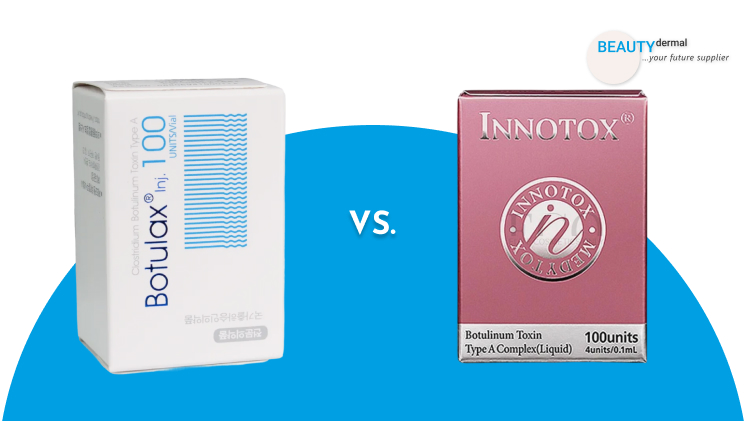
Botulax and Innotox are both Korean botulinum toxin type A products, and both reach the same endpoint: temporary chemodenervation of the injected muscle. The practical differences sit upstream of that, in how the vial arrives, what it contains besides the toxin, and what the clinic has to do before the first injection.
This comparison covers formulation, preparation, onset, storage and immunogenicity considerations, so a practitioner can decide which product fits their workflow rather than which one is nominally better.
| Feature | Botulax | Innotox |
|---|---|---|
| Manufacturer | Hugel | Medytox |
| Presentation | Lyophilized powder requiring reconstitution | Ready-to-use liquid in a single-use vial |
| Stabilizer | Contains human serum albumin | Albumin-free, stabilized with methionine and polysorbate |
| Preparation | Manual dilution with 0.9% saline, dose flexibility | No dilution step, fixed concentration |
| Dosing control | Adjustable through dilution, variable if technique differs | Standardized between sessions |
| Storage | Refrigerated storage before reconstitution | Refrigerated, with liquid format simplifying handling |
Botulax is a botulinum toxin type A produced by Hugel in South Korea, supplied as a freeze-dried powder in the conventional format familiar from most toxin brands. It contains human serum albumin as a stabilizer and is reconstituted with sterile saline before injection.
Its active substance, letibotulinumtoxinA, holds FDA approval in the United States under the brand name Letybo, with phase 3 trials in glabellar lines behind that approval. That is worth stating precisely: the approval covers the US-marketed brand, not the Korean-market Botulax packaging that clinics buy internationally.
Innotox is Medytox’s liquid botulinum toxin type A. It arrives as a sterile pre-mixed solution, so there is no reconstitution step, and it is formulated without human serum albumin, using methionine and polysorbate as stabilizers instead.
The clinical rationale for a liquid toxin is consistency: removing the dilution step removes one source of dose variation between sessions and between practitioners in the same clinic.
A randomized study of liquid-type botulinum toxin type A in moderate to severe glabellar frown lines reported efficacy and safety consistent with conventional lyophilized preparations, which is the clinical basis for the ready-to-use format (Kim et al., Plastic and Reconstructive Surgery, 2015).
The albumin question is the one patients occasionally ask about directly. Botulax uses human serum albumin, a standard stabilizer across the toxin category; Innotox does not, which makes it the option to reach for when a patient reports albumin sensitivity.
The reconstitution difference cuts both ways. Manual dilution gives the practitioner control over concentration and therefore over how the dose spreads through tissue, which experienced injectors often prefer. It also introduces a step where errors happen, and a fixed-concentration liquid removes that step entirely.
Reported onset is slightly faster with Innotox, with effects typically described from around two to three days, against roughly three to seven days for conventional lyophilized products including Botulax. Duration for both sits in the usual three to four month range for aesthetic indications, with individual variation driven by dose, muscle mass, treatment area and patient metabolism.
Claims of substantially longer duration for either product should be treated cautiously: the published comparative data do not support a clear separation, and individual variation is wide. Our guides on how long Botulax takes to work and how long Innotox takes to work cover the timelines in more detail.
Botulax is stored refrigerated before reconstitution, and once reconstituted it should be used within the window stated in the product information. Innotox is refrigerated as supplied, and because it ships ready to use, there is no reconstituted-product window to track separately.
For clinics running multiple sites or handling stock across locations, that difference in handling steps is often the deciding factor rather than any clinical distinction between the two toxins.
Repeated exposure to botulinum toxin can generate neutralizing antibodies, and loss of response over time is a recognised phenomenon across the category. Protein load, injection interval and cumulative dose are the factors usually discussed in that context.
Neutralizing antibody formation remains the main immunological cause of secondary non-response to botulinum toxin, with formulation composition, dose and treatment interval among the contributing factors (Wee and Park, Archives of Plastic Surgery, 2022).
Innotox’s albumin-free composition is frequently cited in this discussion, but the practical controls remain the same for both products: appropriate dosing and adequate intervals between sessions.
Innotox suits practitioners who want preparation removed from the workflow, value session-to-session consistency, or treat patients with albumin sensitivity. Botulax suits those who prefer control over dilution, work with a familiar lyophilized format, or want the flexibility to adjust concentration by treatment area.
Neither is the better product in the abstract. Both are established in aesthetic practice, and the decision usually follows workflow and injector preference rather than a difference in outcome. For a wider comparison across the category, see our Nabota vs Dysport guide, and for the safety questions patients raise most often, our article on whether Innotox is safe.
Licensed specialists can order Innotox 100U and Botulax (Letybo) 100U alongside the wider Korean botox and botulinum ranges at BeautyDermal.
No. Innotox is supplied as a sterile pre-mixed liquid in a single-use vial, so it is used without reconstitution. Botulax arrives as a freeze-dried powder and must be dissolved in 0.9% saline before injection, which gives more control over concentration but adds a preparation step.
Innotox is generally described as having a slightly earlier onset, with effects appearing around two to three days after injection, while Botulax follows the conventional timeline of roughly three to seven days. Individual response varies with dose, treatment area and patient factors.
The Korean-market products themselves are not sold under FDA approval in the United States. The active substance in Botulax, letibotulinumtoxinA, is FDA-approved under the brand name Letybo following phase 3 trials in glabellar lines. Innotox does not currently hold FDA approval.
Innotox, since it is formulated without human serum albumin and uses methionine and polysorbate as stabilizers instead. Botulax contains human serum albumin, which is the standard stabilizer across most botulinum toxin products.
Both typically produce results lasting around three to four months in aesthetic indications. Duration depends on dose, muscle mass, treatment area and individual metabolism, and the published comparative data do not support claims of a substantially longer effect for either product.