0
0 item
View CartYour cart is empty
MON - FRI 10:00 AM - 06:00 PM EST.
SAT - SUN holiday
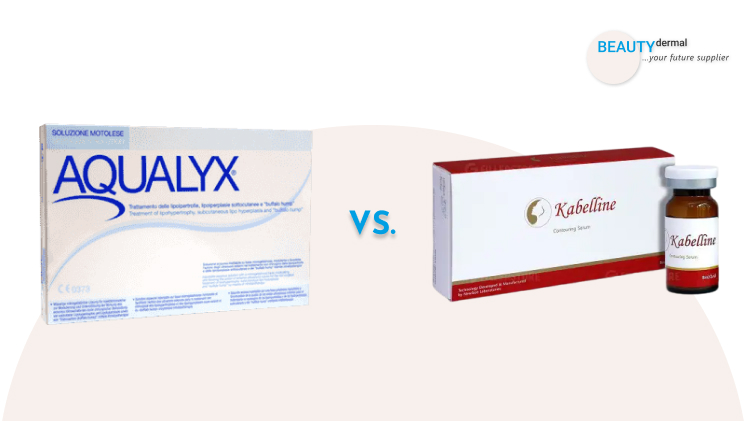
Kybella and Aqualyx come up in the same conversations because both reduce localized fat with a deoxycholate-based injectable. That is where the similarity ends. One is a prescription drug with a single approved indication and a phase 3 evidence base; the other is a medical device used across a much wider range of body areas, with a correspondingly different evidence profile.
For a clinic deciding what to stock, the distinction matters more than any claim about which product dissolves fat harder. This comparison sets out what each product is, where each is used, and how to choose between them for a given patient.
Note:
Outside the United States, Kybella is marketed as Belkyra. The formulation is the same; the brand name differs by market.
Kybella is the brand name for ATX-101, an injectable formulation of synthetic deoxycholic acid at 10 mg/mL. It holds FDA approval for improving the appearance of moderate to severe convexity or fullness associated with submental fat in adults. That indication is narrow by design: the approval covers fat beneath the chin, and nothing else.
Aqualyx is a sodium deoxycholate solution in a microgel carrier, positioned as a medical device rather than a drug. It is used in a technique its developers call intralipotherapy, and in practice it is applied to localized deposits across the body rather than to one approved area. It has no FDA approval, which is not a quality judgment but a different regulatory pathway with different evidence requirements.
Deoxycholic acid is a bile acid that disrupts adipocyte cell membranes when delivered into subcutaneous fat. The damaged cells release their contents, and the resulting debris and lipids are cleared over the following weeks by the body’s normal inflammatory and metabolic processes. Two consequences follow directly from that mechanism.
First, the result develops gradually rather than appearing at the end of the appointment. Second, the local inflammatory response is part of the treatment rather than a complication, which is why swelling, tenderness and induration are expected findings rather than warning signs.
In the REFINE-1 phase 3 programme, ATX-101 produced significantly greater reductions in submental fat than placebo across both clinician-rated and patient-rated scales, with treatment-related adverse events concentrated at the injection site (Jones et al., Dermatologic Surgery, 2016).
Kybella’s strength is the specificity of its indication. For a patient whose concern is a defined pocket of submental fat, the product has a regulatory approval, a published phase 3 evidence base and a defined treatment protocol behind it. The label permits up to six treatment sessions, spaced at least one month apart, with the number of sessions guided by the patient’s response.
Patient selection carries most of the outcome. Submental appearance is shaped by skin laxity, platysmal banding, bone structure and previous procedures as much as by adipose volume, and a patient with substantial laxity may see the fat reduce without the contour improving. Assessing which component dominates is the part of the consultation that determines satisfaction.
Note:
Kybella produces a pronounced inflammatory response in the treated area. Swelling, bruising, numbness and firmness are common in the days after treatment, so patients should schedule around social and professional commitments.
Aqualyx occupies a broader practical role. Because it is used across localized deposits on the abdomen, flanks, thighs, knees and upper arms, it suits clinics whose patients present with small, resistant pockets rather than with a single submental concern. Protocols typically involve several sessions spaced a few weeks apart, with the number guided by area size and response.
The evidence base is thinner than Kybella’s and comes largely from smaller studies and clinical series rather than from a phase 3 programme. Ultrasound-guided technique has been examined as a way to improve placement accuracy in localized deposits, which is a reasonable indicator of where the practical interest lies.
| Feature | Kybella (Belkyra) | Aqualyx |
|---|---|---|
| Regulatory status | FDA-approved prescription drug | Medical device pathway, no FDA approval |
| Active principle | Synthetic deoxycholic acid, 10 mg/mL | Sodium deoxycholate in a microgel carrier |
| Approved or typical area | Submental fat only | Localized deposits across the body |
| Evidence base | Phase 3 randomized trials | Smaller studies and clinical series |
| Session count | Up to six per label, one month apart | Several sessions, guided by area and response |
| Local response | Pronounced swelling and induration | Generally described as more moderate |
The useful question is not which product is stronger but which fits the case in front of you. Practical criteria:
Across the phase 3 dataset, adverse events with ATX-101 were predominantly local, transient and associated with the treatment area rather than systemic in nature (Humphrey et al., Journal of the American Academy of Dermatology, 2016).
Direct head-to-head randomized evidence comparing the two products is not available, so claims that one outperforms the other should be read as clinical impression rather than trial data. Where skin quality rather than fat volume drives the complaint, a different modality may serve better: our guide to PDO thread lift before and after covers one such alternative.
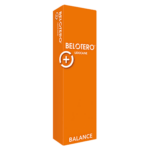
Both products have a defensible place in a professional portfolio, and they answer different questions. Licensed specialists can order Belkyra 4x2ml for submental work and Aqualyx 10 vials for localized body contouring, alongside the wider dermal fillers and mesotherapy ranges at BeautyDermal.
No. Both work through deoxycholate-based disruption of fat cell membranes, but they are separate products with different formulations and regulatory routes. Kybella is a prescription drug containing synthetic deoxycholic acid at 10 mg/mL, approved for submental fat. Aqualyx is a sodium deoxycholate microgel supplied under a medical device framework and used on localized deposits across the body.
Kybella holds FDA approval for moderate to severe submental fullness in adults and is sold as Belkyra in several markets outside the United States. Aqualyx has no FDA approval and follows a device pathway, so practitioners should confirm what their own regulator permits before offering it.
The Kybella label permits up to six treatment sessions spaced at least one month apart, with the actual number guided by patient response. Aqualyx protocols also run across several sessions, with the count depending on the size of the area treated and how the tissue responds.
Yes. Deoxycholate-based lipolysis works by disrupting fat cell membranes, so a local inflammatory response is part of the mechanism rather than a complication. Swelling, bruising, tenderness, numbness and firmness are commonly reported, and Kybella in particular produces a pronounced response in the treated area.
No. Both products are intended for localized adipose deposits in patients close to their target weight, not for generalized fat reduction. Setting that expectation during consultation is one of the strongest predictors of patient satisfaction with the result.